Wednesday, April 23, 2008

Diagnosing a common problem

I had just finished loading a set of 30-06 Springfield 110 grain rounds for my Winchester Model 70. Beautiful rifle, a pre 1964 style Mauser action they call the "Classic". Here's a pic.

24" barrel, fantastic cut of walnut for the stock, you have to see it to be able to make out the good looking shades and grains in the wood. Great bluing job, very satiny black finish and it's wearing a Bushnell 3-9x50mm 3200 Elite scope in Leupold rings.


Here's the trouble. When I chambered the rounds, some chambered just fine and others offered a degree of resistance.

Now, there are several possible explainations with that. One could be the bullets being seated too far forward, so that on chambering, the bullet is being driven against the rifling. It should not be encountering rifling, as this will affect your pressure, jacking it up and possibly causing bad results.

But I checked the round. They measured the 3.170" I wanted, and factory rounds with different bullets are much longer. So that's not it.

Maybe the shoulder was not set back far enough? When you use a reloading press to force fired brass into a full length sizing die, it compacts it by squeezing it back to what should be factory dimensions. If your die is not screwed into the press to the proper depth though, the casing won't be pushed in far enough to be properly resized.

But no, comparing the length to drawing and schematics, and to a factory round. Shoulders were fine.

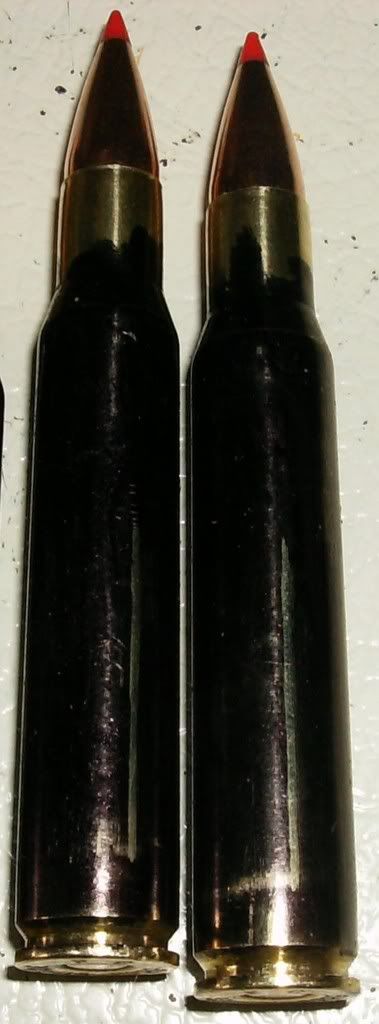
After talking to some friends online who forget more about reloading than I will ever know, I narrowed down the cause. It took coating the bullets in black magic marker to become apparent. On chambering, whichever part of the round is making the friction, it will have the magic marker scraped off and you can immediately see your bugbear.


You can see my problem right off, starting a quarter inch up from the bottom of the case. The case head is too large.

Turns out the explaination is really simple.

This brass came from my M1 Garand and was mixed into my other 30-06 casings. The Garand (as do most military rifles) has a larger chamber, so the casings are coming out with a funny shape. If I cannot load a bullet quickly, it is at worst an inconvenience. For a US soldier or Marine in 1944, it was a matter of life and death. Their ammo was sometimes gritty and dirty, and sometimes not all made to the exact same specs. To feed easier, chambers were slightly larger than those in civilian rifles.

My RCBS full length die doesn't have the horsepower to cram the Garand brass case heads back to proper shape. There's two possible remedies. The first is buying a small base die, a special die made just for this problem, or switching to a Lee die set. I like my Lees and they seem to form a little tighter. I think I'll try the Lee.

The good news is, I can still shoot this ammo for now. It's just a little stiff to chamber.

Hope this helps someone someday!

Handloading at last!

Yup, I finally took the plunge into the world of reloading!

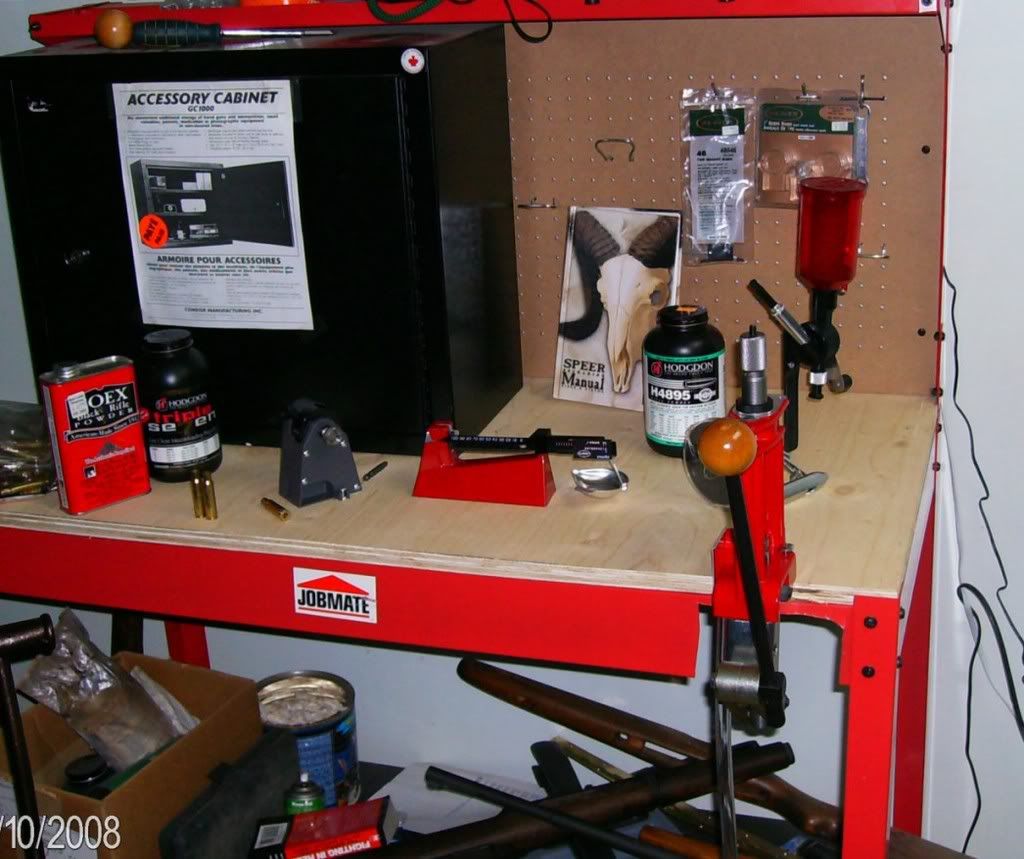
Here's my setup.


It's a Lee Challenger kit, including a press, powder scale, powder measure, case care tools and a hand primer.

I've also picked up a Lee Zip Trim case trimmer, that little grey thing bolted to my desk in front of the safe. Great piece of kit. You lock an empty case into the chuck and pull a cord to spin it against a cutter to return it to factory length.


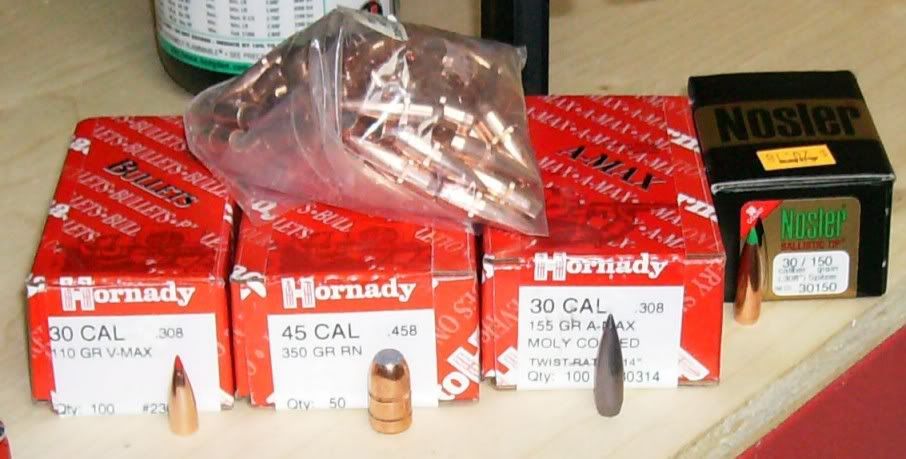
A selection of bullets: .308 caliber 110 grain V-max, .458 caliber 350 grain round nose soft point, .308 cal 155 grain moly coated A-max and .308 cal 150 grain Ballistic tip. The bag on top is military style 150 grain .30 cal FMJ for cheap shooting.

The V-max is a wonderful little bullet, typically used for varmint shooting. As such, it's light, flies very fast, and expands and fragments extremely violently. Another plus is that it is a light kicker. Being light, there is less recoil due to the fact that less inertia is being pushed out of the rifle. It's got a great potential for accuracy.

The A-max is a more balanced long range match or competition loading, which retains it's energy and velocity a lot better than the lighter V-max, and offers more stability and aerodynamics for long range shooting.

The .458 cal soft point is a big game load for use in a 45/70 or .458 Win Mag. Ideal for the moose around here! Hard kicking, but hard hitting on the other end too.

As of now, I am equipped to load 30-06 Springfield, 308 Winchester, 300 Winchester Magnum, 8x57mm Mauser, and 45/70 Government. Soon to add 30/30 Winchester, .45 ACP, .303 British and .30 Caliber M1 carbine to the list.

So far so good. Not only is it cheaper than factory ammo, it gives you much more control over what kind of ammo you can make, and the consistant nature coming from the amount of care you put in goes a long way in obtaining accuracy.

Here's a .308 Winchester load I am working up, starting with a Federal casing, Winchester LR primer, 45 grains of H-4895 powder and a 110 grain V-max seated to 2.800" overall length.


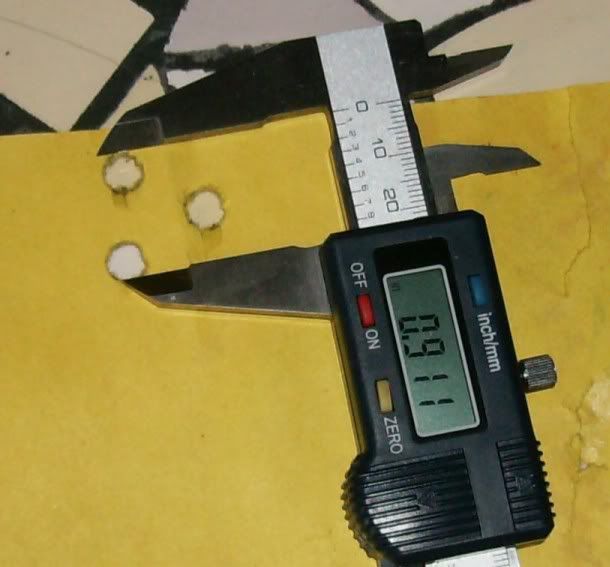
That's .602 of an inch at 100 meters. The rifle is a Stevens 200, with a previous best grouping of right around the 1 inch mark with factory ammo. Almost cut in half!

Sunday, December 30, 2007

Russian Captured Kar 98K

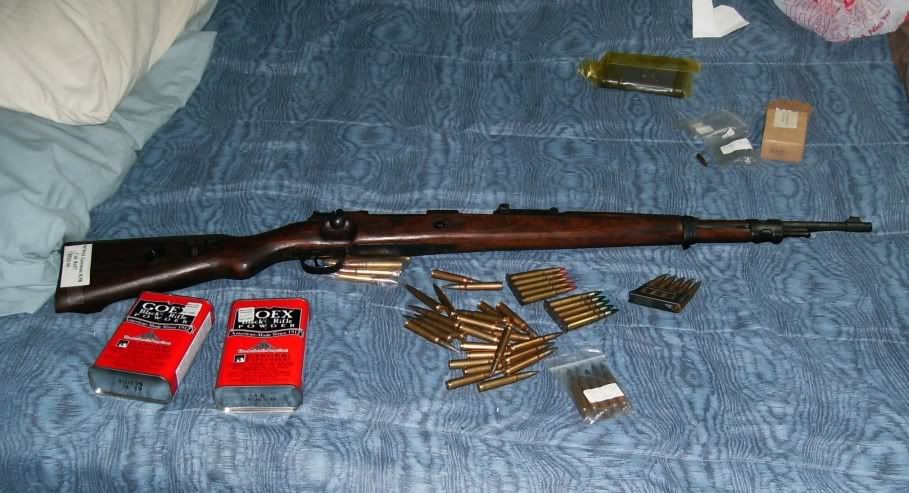
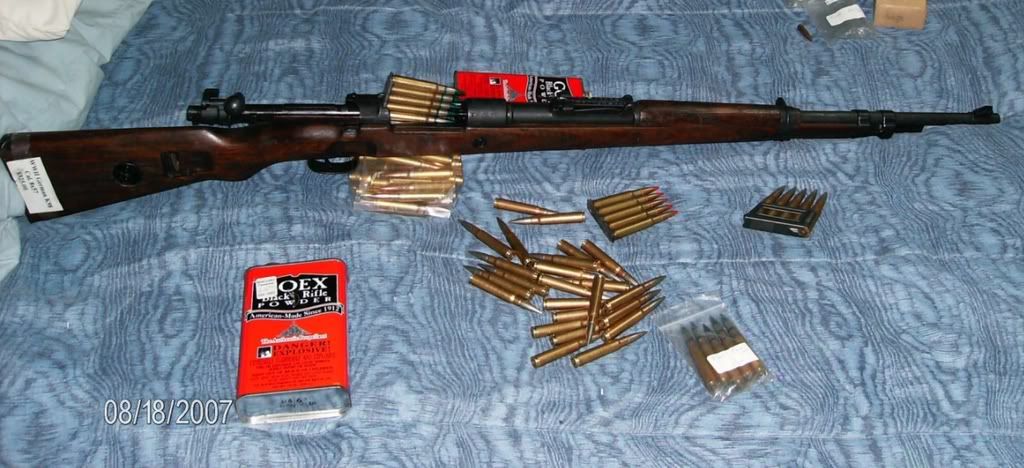
Here's a couple pictures of a great pick for any rifle entusiasts...A Mauser Kar 98k that was captured by the Soviets during WW2.

Aside from any historical value, what attracts me is that the rifle is cheap. Actually, less than half the price of an unaltered German Kar 98k. The Russians refinished the wood in a crude kind of varnish, and assembled the rifle from a mized batch of parts, with electropenciled serial numbers on the bolt and elsewhere. Overall, it does remove some attractiveness, but it's still a Kar 98k and a German made one at that.

Their job of rebluing is actually quite nice too. A great hot-dip blue job, which is dark and handsome.

This particular one coded S/243, denoting that it was made in the Mauser Borsigwalde factory, and dated 1937. The bore has a little frost from having used corrosive ammo but on the whole is very good. The strong points of the design are well shown. I picked up a stash of both Equadorian and Romanian ammo, and a goodly supply of FN AP and Tracer. So far, it likes both, and is a pretty accurate shooter. Careful grouping usually stays under 3 inches, and with the limitations of Mauser sights, thats just fine for me. 8mm Mauser ammo is a pretty hot number too, pushing a 196 grain .323 caliber ball at 2550 fps or a 150 grain ball at 2900.

Cheap surplus ammo abounds, a great hunting rifle with some rockin stopping power. Tough as nails to boot. For $325, a righteous buy.


Friday, November 30, 2007

New Gun Time!

YAY!

While I was gone workin in some of the armpit of Canada, I naturally saved up enough bread to buy tons of new guns!

Among them, a Mossberg 500 Persuader, a Winchester Model 70 Classic in 30-06 Springfield, a Mauser Kar 98k that was captured by the Soviets and an H&R Buffalo Classic in 45/70 Government! (And a Norinco 1911 on the way, but more on that another day).

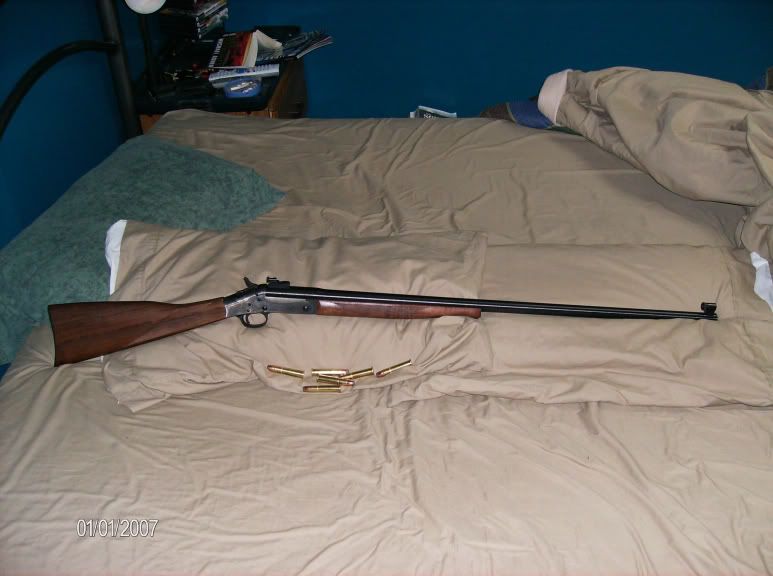
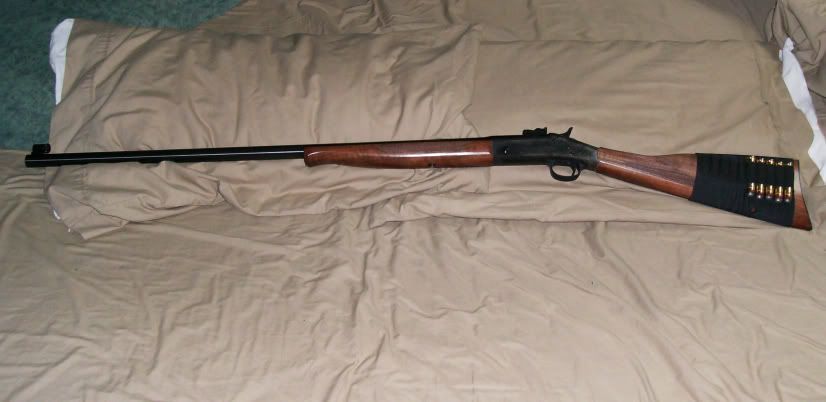
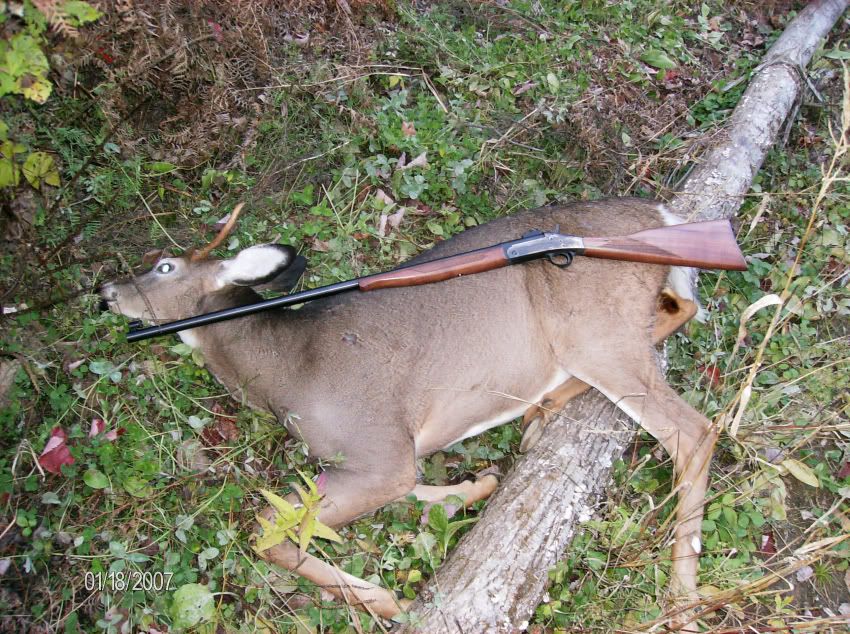
Here's some pics of the Buffalo Classic. It sports some beautiful wood, a 32" barrel for a nice long sight radius, and a Williams sight set featuring a rear aprerture and a front sight with 8 interchangable inserts.

Quite an accurate rifle. It's capable of sub 2" at 100 meters with this monkey pulling the trigger, which happens to be wonderfully light and crisp. Extraordinary stopping power and on game effectivness too!

Finallly back! With good news and bad

Whoa, was that ever a hiatus!

Happy to say after one hell of a summer and a great fall, Canadian Shooter is up and running again.
And in my first new post, I bring us Holiday tidings...Both good and bad.

The good news is we have theUN monkey off of our backs for the time being. For those who aren't in the know, the UN has mandated that all newly produced firearms need to be stamped with their country of origin, and this stamping must comply with how the UN says it is to be done. So far the countries who have signed on to this bill are a collection of either third world dictatorships or jokes. Including this one.

The magic date (Dec. 7, 2007...How is that for another day of infamy?) was fast approaching, and the US gun manufacturing companies had almost all given a "no" to stamping their guns.

Think about that for a sec. No new US guns. No military surplus firearms entering the country. What would that do to our shooting industry? Most likey cripple it overnight, and spike the prices of guns already in the country dramatically.

The UN actually has the nerve to tell us that this is to help end conflicts like those in Africa. Right. Because in a world with over 22,000,000 AK-47s out there and where tin pot republics can buy fighter jets and gunship helicopters for what I make in a year, Africa would be sooo much safer, and there would be no more child soldiers and conflict diamonds, and we could all sing "koumbaya" if my guns have a special UN stamp on them.

Right. Don't piss a global gun control scheme and socialist engineering of society down my back and tell me it's raining. This is the same UN which has said there is no international right to armed self defense. You know, if I were paranoid, I might actually see them doing something like standing by and letting an African genocide take place, with policies like that!

Oh, wait....They did. I am so happy we have the Third World Debating Club to tell us how to run our country.

End sarcasm now....We dodged a huge bullet, even if D-Day was only postponed to December, 2009. Two more glorious, gun filled years for all of us and more time to slay this dragon.

And the bad news....

Our Quebec "Representatives" the FTQ have taken it upon themselves to speak for all of us before the Government again, saying proudly that they would support removing military style firearms and certain pistols from the hands of law abiding gun owners.

Whiskey...Tango...Foxtrot....Over?

Here...watch it straight from the horse's mouth...their president. Video is in French.

http://diffusion.assnat.qc.ca/video/ci/ci200710171645.wmv

Wow, there you have it. Why do the represent us? Because the Govt says they are the only organization that does! Coincidentally they are also the only organization that receives funding from Charest's Govt. Go figure.

Now I would hope this guy is scared to answer the phone and that his inbox has been spammed to hell in back, but I forgot the large part of Canadian gun owners who are content with the thought of being cuddled and sweet talked after the prison style butt reaming is done, don't I?

So here is what I did. I found every e-mail for every gun store and shooting club in Quebec I could get my grubby little hands on (Sadly this barely breaks one hundred...It's 2007 guys, get yourselves online!) and started mass mailing them the video clip. Hopefully they spread it around. Some signs in stores and shooting clubs would also be greatly appreciated.

Way to go, FTQ. With "friends" like you, we don't need enemies! Vidkun Quisling would be VERY proud.

If anyone else out there values their rights whatsoever, here's their contact info. Let 'em have it!!!

fqt@fqtir.qc.ca

ppaquette@fqtir.qc.ca

Sunday, July 8, 2007

Canada legal STEN?


Yeah, supposed to be! Word is, STENs are back, have been approved as Restricted class, and are registered!

Trick is, you have to buy an unfinished semi auto only reciever and an old parts kit.

But it's certainly doable.

This sounds like a job for Joel!

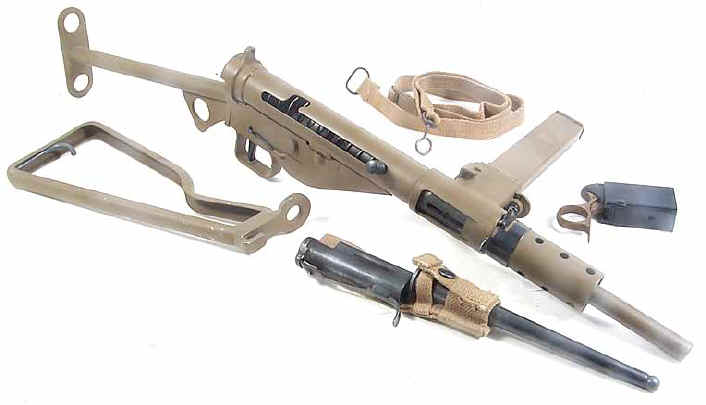
For those of ya who ain't familiar with it, the STEN was an economical British designed 9mm submachine gun from the Second World War. Made largely of sheet metal stampings, they were effective and very cheap and fast to produce.

Not the best lookin SMG ever, but they work.

Sunday, July 1, 2007

Unsafe muzzle loaders?

Hey all,

I read this and cringed.

I am not sure how, if this is in fact the case, some retailers are allowed to pull off such a horrible marketing malpractice.

These are comments by Randy Wakeman, taken from the Chuck Hawks website.


"As scrutiny of the muzzleloading market quickly reveals, there are no muzzleloading standards. There are no standards for metal, bore-size, testing, or much of anything. SAAMI and the CIP have clear standards for rimfires, pistols, shotguns, as well as rifles, but it is a brave new world when you look at muzzleloaders. It is quite a mess, and has been for a long time. The term "Magnum Muzzleloader" means nothing specific at all, it's just another meaningless marketing label.

So, how do we know what a muzzleloader of reasonable build quality should do? Good question, as the manufacturers have still failed to set minimum standards or otherwise control themselves. Companies that are, in my opinion, sleazy and smarmy like "CVA" and "Traditions" can make muzzleloading a lousy to place to be.

Pressure information has long been available, as evidenced in the LYMAN Black Powder Handbook & Loading Manual written by Sam Fadala. Lyman Ballistic Laboratories data has been above reproach for decades. If you check pages 172-177 of the second edition of the Lyman book, you will quickly obtain a grasp of what muzzleloading pressures may be. You'll see that 120 grains by volume of Pyrodex RS pushing a 240 grain Hornady sabot can develop 29,900 PSI. You'll find many, many loads developing well over 25,000 PSI peak pressure. A three pellet load can develop 29,000 PSI peak pressure, as shown by Lyman. That still isn't the top pressure loads that are published; some are well above 30,000 PSI with 120 grains of Pyrodex. Loose powder loads heavier than 120 grains by volume of Pyrodex are not touched upon, though heavier loads and hotter propellants than Pyrodex are in common use.

Based on all this, the "Question" becomes obvious. If an inline muzzleloading manufacturer refuses to tell you in writing that their rifles have been designed and tested to withstand a constant diet of 30,000 PSI peak pressure loads safely, their guns should not be sold, much less used.

This is such a basic, common-sense question that no inline muzzleloading manufacturer should have any problem answering it without hesitation. If they can't, they are richly deserving of all the scorn and condemnation that we can lavish on them. It is bad metallurgy and lack of testing that keeps 911 busy for some unfortunate victims year after year."


And more....


"
It is a sad fact that many muzzleloaders produced today with Spanish barrels are marked with a pressure rating of 700 kp/cm? clearly stamped on the barrels. Relying on the ignorance of the muzzleloading community, aren't they are the most popular barrels sold in the USA today? The dirty secret is that the proof rating above is converted to psi by the following formula: kp/cm? x 14.22 = psi. Directly put, these barrels are factory marked to a maximum pressure of 9954 psi.

It is also well documented that so-called magnum loads, for example 150 grains of Pyrodex pushing a 260 grain saboted projectile can easily develop pressures exceeding 20,000 psi. Much more moderate charges of 100 grains of Pyrodex pushing the same 260 grain saboted bullet can easily develop pressures in the 13,000-14,000 range. In fact, the original Pyrodex pellet patent states this quite clearly, to name only one document.

Do these soft, low-pressure barrels have any business being fired with loads that create more than twice the stamped barrels pressure rating? Does this create an unnecessary risk both to the shooter, and to those around him? Will it likely take death or dismemberment and the resultant lawsuits for this to change?

Some may think my barrel safety questions inappropriate. Why would any manufacturer market borderline or untested product? Why would Enron steal money from its employees, why would Morton-Thiokol okay space shuttle O-ring systems their engineers had severe reservations about? Must it take a "60 Minutes" expose or loss of life to change or improve things?

Would anyone in their right mind reload a smokeless cartridge to twice the SAAMI specifications? Don't today's muzzleloading companies actively promote similar practices? Who is more stupid, the people that ignore pressure ratings on barrels or the companies that tell you it is somehow "okay" to fire charges in barrels that have never been individually tested to take such pressures?

Call me dense, but what smokeless powder firearms manufacturer directs you to set off any single load in any single gun at near proof pressure in any barrel under any circumstances, much less exceed it? Yet, some muzzleloading companies, apparently, do it all the time. Wouldn't a lot of people like to know what that might have to do with their gun, and what pressure their gun is really proofed for? Pressure limits are no secret in SAAMI / smokeless-land; in muzzleloading, they apparently are!

Hodgdon Powder Co. has long warned that either 100 grains Pyrodex pellets in .50 caliber or 100 grains Triple Seven pellets in .50 caliber is the MAXIMUM ALLOWABLE LOAD. When muzzleloading manufacturers deviate from the propellant maker's warnings, the burden is on them to prove its safety.

Are they dangerous? I don't know. Have they ever been shown to be safe with high-octane loads? How does a modern shooter know what his gun is capable of? Shouldn't modern muzzleloaders be proved safe prior to sale? Isn't this a reasonable question for any gun owner to ask?

I think it most certainly is.

Addendum:

There are two basic types of "proof." "Provisional" proof that applies generally to barrels in the early stages of manufacture, to prevent the maker from continuing work on defective tubes. Definitive proof applies to all arms and is effected "in the white" or in the finished state.

Inspection of many Traditions and CVA guns will clearly show the Spanish House of Eibar definitive black powder proof mark. Likely you will also see the ammunition inspection proof mark as well. A pressure stamping on the barrel, typically 700KP/CM2, will follow this. That pressure is expressed in "kiloponds / cm2." The equivalent in PSI is approx. 9957 PSI.

It is well documented that 150 grain Pyrodex pellet loads pushing 250 to 300 grain saboted projectiles can exceed 2.5 X that pressure, often upwards of 25,000 - 27,000 PSI. These are common loads, not "unusual" loads. Not just the original Pyrodex patent, but many readily available independent sources such as Lyman's.

There is no evidence to show that these barrels are tested stateside in any way, and there is evidence to show that they are not, as in imported muzzleloaders arriving here a day or so after clearing customs.

If there is further testing beyond what is clearly stamped on the barrels, it is unknown--and not reflected on the original substandard proof embossed on those barrels. Nor is there any supplementary proof to indicate that this is being done.

The simple question, posed again and again, is have those guns been proofed or tested to 20,000 PSI, 25,000 PSI, or 30,000 PSI? If so, who is doing the testing, and what guns are being tested? Why are there no marks to indicate a "tested" barrel from an untested one? What specific loads are they tested with? Are they tested with pellets at all? What metal is used in these soft, extruded barrels? How do I know that my gun has been tested beyond the internationally respected house of Eibar stamp?

What reasonable assurances can be provided to a customer so he knows his individual gun has been tested?

Somehow, a terse phone call from a manufacturer that says these proofs are "not really proof marks" or "just a manufacturing mark" or "minimum pressures" or "it is ALL hogwash-- just follow the manual" seems ill-prepared, clumsy, and insufficient.

Traditions and CVA / BPI have been aware of these questions for some time. They have been unable to answer or fully address them. (Unless you think that Traditions calling me "anti-Second Amendment" or CVA starting a "Randy, you are out of your mind" thread on their forum should be construed as an answer to these questions.)

I don't know what testing there is, with what, by who, and why the Eibar Proof marks remain far, far too low. The public response from Traditions and CVA / BPI has been non-existent. If they can address these issues fully, and put the matter to rest, why haven't they? Traditions and CVA/Winchester Muzzleloading/BPI have been asked again and again why a customer should consider their recommended loads as safe, when they defy the clear barrel proofs, C. I. P. maximum service pressures, and Hodgdon Powder's own maximum load warnings.

With a mess like this, it is clear that the Black Powder Industry desperately needs an overseeing body like SAMMI. Though SAMMI participation is voluntary, it has made the firearms industry a better place by setting the rules. Only those with self-destructive proclivities would knowingly break powder manufacturer's reloading rules. Yet, if you are a muzzleloader, you are a reloader.

The educated consumers can decide for themselves what chances they may or may not be taking. As to if they are tested or safe with "their loads," I cannot possibly say either way. I wish I could say that I believe these guns to be well-tested and proven safe.

The best I can offer remains "I don't know."


Shameful.