Sunday, July 8, 2007

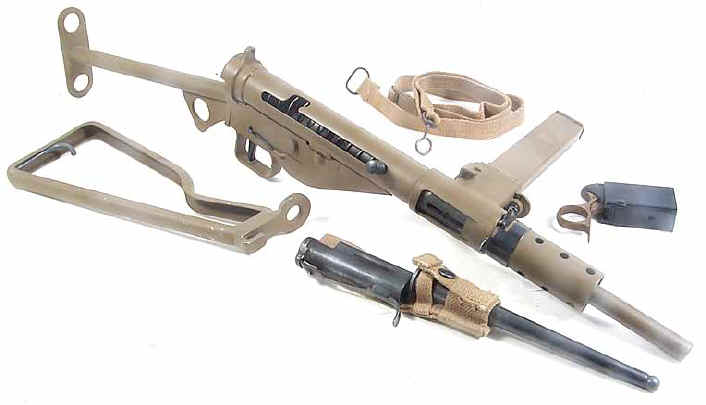
Canada legal STEN?


Yeah, supposed to be! Word is, STENs are back, have been approved as Restricted class, and are registered!

Trick is, you have to buy an unfinished semi auto only reciever and an old parts kit.

But it's certainly doable.

This sounds like a job for Joel!

For those of ya who ain't familiar with it, the STEN was an economical British designed 9mm submachine gun from the Second World War. Made largely of sheet metal stampings, they were effective and very cheap and fast to produce.

Not the best lookin SMG ever, but they work.

Sunday, July 1, 2007

Unsafe muzzle loaders?

Hey all,

I read this and cringed.

I am not sure how, if this is in fact the case, some retailers are allowed to pull off such a horrible marketing malpractice.

These are comments by Randy Wakeman, taken from the Chuck Hawks website.


"As scrutiny of the muzzleloading market quickly reveals, there are no muzzleloading standards. There are no standards for metal, bore-size, testing, or much of anything. SAAMI and the CIP have clear standards for rimfires, pistols, shotguns, as well as rifles, but it is a brave new world when you look at muzzleloaders. It is quite a mess, and has been for a long time. The term "Magnum Muzzleloader" means nothing specific at all, it's just another meaningless marketing label.

So, how do we know what a muzzleloader of reasonable build quality should do? Good question, as the manufacturers have still failed to set minimum standards or otherwise control themselves. Companies that are, in my opinion, sleazy and smarmy like "CVA" and "Traditions" can make muzzleloading a lousy to place to be.

Pressure information has long been available, as evidenced in the LYMAN Black Powder Handbook & Loading Manual written by Sam Fadala. Lyman Ballistic Laboratories data has been above reproach for decades. If you check pages 172-177 of the second edition of the Lyman book, you will quickly obtain a grasp of what muzzleloading pressures may be. You'll see that 120 grains by volume of Pyrodex RS pushing a 240 grain Hornady sabot can develop 29,900 PSI. You'll find many, many loads developing well over 25,000 PSI peak pressure. A three pellet load can develop 29,000 PSI peak pressure, as shown by Lyman. That still isn't the top pressure loads that are published; some are well above 30,000 PSI with 120 grains of Pyrodex. Loose powder loads heavier than 120 grains by volume of Pyrodex are not touched upon, though heavier loads and hotter propellants than Pyrodex are in common use.

Based on all this, the "Question" becomes obvious. If an inline muzzleloading manufacturer refuses to tell you in writing that their rifles have been designed and tested to withstand a constant diet of 30,000 PSI peak pressure loads safely, their guns should not be sold, much less used.

This is such a basic, common-sense question that no inline muzzleloading manufacturer should have any problem answering it without hesitation. If they can't, they are richly deserving of all the scorn and condemnation that we can lavish on them. It is bad metallurgy and lack of testing that keeps 911 busy for some unfortunate victims year after year."


And more....


"
It is a sad fact that many muzzleloaders produced today with Spanish barrels are marked with a pressure rating of 700 kp/cm? clearly stamped on the barrels. Relying on the ignorance of the muzzleloading community, aren't they are the most popular barrels sold in the USA today? The dirty secret is that the proof rating above is converted to psi by the following formula: kp/cm? x 14.22 = psi. Directly put, these barrels are factory marked to a maximum pressure of 9954 psi.

It is also well documented that so-called magnum loads, for example 150 grains of Pyrodex pushing a 260 grain saboted projectile can easily develop pressures exceeding 20,000 psi. Much more moderate charges of 100 grains of Pyrodex pushing the same 260 grain saboted bullet can easily develop pressures in the 13,000-14,000 range. In fact, the original Pyrodex pellet patent states this quite clearly, to name only one document.

Do these soft, low-pressure barrels have any business being fired with loads that create more than twice the stamped barrels pressure rating? Does this create an unnecessary risk both to the shooter, and to those around him? Will it likely take death or dismemberment and the resultant lawsuits for this to change?

Some may think my barrel safety questions inappropriate. Why would any manufacturer market borderline or untested product? Why would Enron steal money from its employees, why would Morton-Thiokol okay space shuttle O-ring systems their engineers had severe reservations about? Must it take a "60 Minutes" expose or loss of life to change or improve things?

Would anyone in their right mind reload a smokeless cartridge to twice the SAAMI specifications? Don't today's muzzleloading companies actively promote similar practices? Who is more stupid, the people that ignore pressure ratings on barrels or the companies that tell you it is somehow "okay" to fire charges in barrels that have never been individually tested to take such pressures?

Call me dense, but what smokeless powder firearms manufacturer directs you to set off any single load in any single gun at near proof pressure in any barrel under any circumstances, much less exceed it? Yet, some muzzleloading companies, apparently, do it all the time. Wouldn't a lot of people like to know what that might have to do with their gun, and what pressure their gun is really proofed for? Pressure limits are no secret in SAAMI / smokeless-land; in muzzleloading, they apparently are!

Hodgdon Powder Co. has long warned that either 100 grains Pyrodex pellets in .50 caliber or 100 grains Triple Seven pellets in .50 caliber is the MAXIMUM ALLOWABLE LOAD. When muzzleloading manufacturers deviate from the propellant maker's warnings, the burden is on them to prove its safety.

Are they dangerous? I don't know. Have they ever been shown to be safe with high-octane loads? How does a modern shooter know what his gun is capable of? Shouldn't modern muzzleloaders be proved safe prior to sale? Isn't this a reasonable question for any gun owner to ask?

I think it most certainly is.

Addendum:

There are two basic types of "proof." "Provisional" proof that applies generally to barrels in the early stages of manufacture, to prevent the maker from continuing work on defective tubes. Definitive proof applies to all arms and is effected "in the white" or in the finished state.

Inspection of many Traditions and CVA guns will clearly show the Spanish House of Eibar definitive black powder proof mark. Likely you will also see the ammunition inspection proof mark as well. A pressure stamping on the barrel, typically 700KP/CM2, will follow this. That pressure is expressed in "kiloponds / cm2." The equivalent in PSI is approx. 9957 PSI.

It is well documented that 150 grain Pyrodex pellet loads pushing 250 to 300 grain saboted projectiles can exceed 2.5 X that pressure, often upwards of 25,000 - 27,000 PSI. These are common loads, not "unusual" loads. Not just the original Pyrodex patent, but many readily available independent sources such as Lyman's.

There is no evidence to show that these barrels are tested stateside in any way, and there is evidence to show that they are not, as in imported muzzleloaders arriving here a day or so after clearing customs.

If there is further testing beyond what is clearly stamped on the barrels, it is unknown--and not reflected on the original substandard proof embossed on those barrels. Nor is there any supplementary proof to indicate that this is being done.

The simple question, posed again and again, is have those guns been proofed or tested to 20,000 PSI, 25,000 PSI, or 30,000 PSI? If so, who is doing the testing, and what guns are being tested? Why are there no marks to indicate a "tested" barrel from an untested one? What specific loads are they tested with? Are they tested with pellets at all? What metal is used in these soft, extruded barrels? How do I know that my gun has been tested beyond the internationally respected house of Eibar stamp?

What reasonable assurances can be provided to a customer so he knows his individual gun has been tested?

Somehow, a terse phone call from a manufacturer that says these proofs are "not really proof marks" or "just a manufacturing mark" or "minimum pressures" or "it is ALL hogwash-- just follow the manual" seems ill-prepared, clumsy, and insufficient.

Traditions and CVA / BPI have been aware of these questions for some time. They have been unable to answer or fully address them. (Unless you think that Traditions calling me "anti-Second Amendment" or CVA starting a "Randy, you are out of your mind" thread on their forum should be construed as an answer to these questions.)

I don't know what testing there is, with what, by who, and why the Eibar Proof marks remain far, far too low. The public response from Traditions and CVA / BPI has been non-existent. If they can address these issues fully, and put the matter to rest, why haven't they? Traditions and CVA/Winchester Muzzleloading/BPI have been asked again and again why a customer should consider their recommended loads as safe, when they defy the clear barrel proofs, C. I. P. maximum service pressures, and Hodgdon Powder's own maximum load warnings.

With a mess like this, it is clear that the Black Powder Industry desperately needs an overseeing body like SAMMI. Though SAMMI participation is voluntary, it has made the firearms industry a better place by setting the rules. Only those with self-destructive proclivities would knowingly break powder manufacturer's reloading rules. Yet, if you are a muzzleloader, you are a reloader.

The educated consumers can decide for themselves what chances they may or may not be taking. As to if they are tested or safe with "their loads," I cannot possibly say either way. I wish I could say that I believe these guns to be well-tested and proven safe.

The best I can offer remains "I don't know."


Shameful.

Wednesday, June 6, 2007

High Speed Photography

Hey all!

I decided to play with high speed photography tonight...And with my Tokarev. So why not combine the two? Off to the range!

Here's some pics taken within one second, showing the result of a hit from 7.62x25mm on a 2 litre bottle full of water.

The bottle exhibits a clean hole on entry and a slit on exit where pressure cracked the bottle in a straight, clean seam.

That means the military 85 grain steel cased ball does not expand, nor dump energy into the target the way a deadlier hollow point will.

But look at that spray! And in the last picture, you can see how much water is "bleeding" out of the bottle as it falls, becaus of gravity alone.

Nope, the pistol round of a Russian soldier in the "Great Patriotic War" wasn't as deadly as the hollow point, larger caliber rounds our police and we as civilians use today...But nothing to laugh at! And that's from a pistol, not an SMG. If Fritz caught that round in major blood vessels, he was down for the count. A well aimed shot would be all she wrote. Chalk one up for the Motherland.


CTV's Paula Todd: Gun owner "Freakish"

Hey all.

Does anyone else here remember Wayne Chiang? Simply because he had posted pictures of himself with firearms, he was mistaken for being the Virginia Tech shooter.

Well, Wayne was invited to do a CTV interview to speak about Virginia Tech...Instead, he was ambushed on air and insulted off air.

Here is what Wayne has to say about the affair...


"Hey all, thanks for all the support! It means so much to me. The interview with Paula Todd was aired live on Wednesday April 18, 2007. I was supposed to talk about my experience at Virginia Tech, but ultimately ended up blindly walking into a firearms debate/ambush. That's why I look so retarded answering the questions.

The second video with the comments were off-air. CTV was nice enough to send me a copy of the interview and someone let the off-air portions slip through. After watching all the off-air parts, it was interesting to see how she personally greeted all her guests, except for me. She talks to at least seven other people and tells them the topic of discussion before hand. For me, I just ended up on camera talking at a wall to someone I couldn't see or ever heard of before. I suppose this must be the new tactic these news networks use...

Paula Todd: http://www.youtube.com/watch?v=-QSC4RqdMII
Paula Todd #2: http://www.youtube.com/watch?v=5U69ABffO-Y

The other piece of infamy is the picture mixup debacle. This one is just absurd and needs no explanation: http://www.youtube.com/watch?v=TQtdxPl4Ew8"


Hmmm....wait...since I posted this one...something new has developed...

Wayne received this...


"
Dear Member:

This is to notify you that we have removed or disabled access to the following material as a result of a third-party notification by CTV Inc. claiming that this material is infringing:

CTV Paula Todd Thinks Gun Owners Are FREAKISH: (http://www.youtube.com/watch?v=5U69ABffO-Y)
Please Note: Repeat incidents of copyright infringement will result in the deletion of your account and all videos uploaded to that account. In order to avoid future strikes against your account, please delete any videos to which you do not own the rights, and refrain from uploading additional videos that infringe on the copyrights of others. For more information about YouTube's copyright policy, please read the "Copyright Tips" guide: http://www.youtube.com/t/howto_copyright."

Oh.

Okay.

So it's all well and good for terrorists like Hamas and Hezbollah to post their propaganda which actually recruits children to be suicide bombers...But we can't have Wayne posting HIS CTV video! That's crazy talk!

Wednesday, May 30, 2007

MG34

Hey guys,

Sorry no posts lately but I had a BLAST this weekend and just pulled in from O-town on Tuesday...Shot in two competitions on Saturday, but I'll talk more about that in another post.

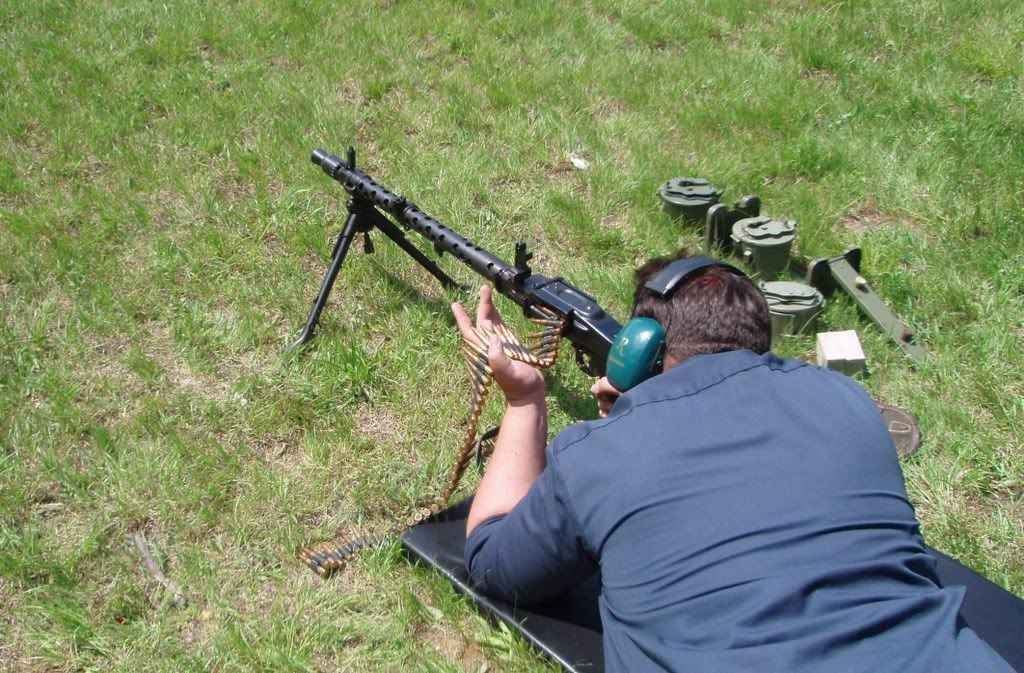
I gotta mention first and foremost that I was lucky enough to get a chance to take a spin on a German MG34.

For those of ya who aren't familiar with it, the MG34 was the first modern universal machine gun. At 12kg, it was much lighter than most other MGs around the world, and could be used for virtually any role.

Nazi Germany began producing them in 1934, and it was used from a bipod, as this one was, in the light machine gun role, with a tripod for a general purpose machine gun, and also in tanks and aircraft.

It had a blistering rate of fire, although not as high as the later MG-42, and fired the powerful 8mm Mauser round. Typically a 199 grain bullet at 2600 feet per second.

It operates by the recoil of the barrel being blown straight back and pushing the bolt to the rear with a massive recoil spring in the buttstock bringing the bolt back into battery. The nose cap at the muzzle end of the rifle uses the gas from firing to assist in this.

It is effective to 1200 yards at least in aimed fire and 2000 yards or more in the indirect fire role, to simply batter an area with ammo.

Recoil was very mild, although this version was only semi automatic, it was quite accurate. Hitting a 10" target with slow fire was a breeze. When you really open her up as fast as you can fire her though, it tends to spray an area. Doesn't kick hard, but you can't keep the sights on target very well either. It pelts the immediate area with ammo. You should see this thing chew up a berm. It's unreal. 8 men firing rifles at the same time was the only thing that even came close to how much damage this thing was doing.

I can say this...our boys who charged these guns in places like Juno beach had some big, BIG brass ones!

Here's me giving it a go.


Wednesday, May 16, 2007

Pictures for Red Collar

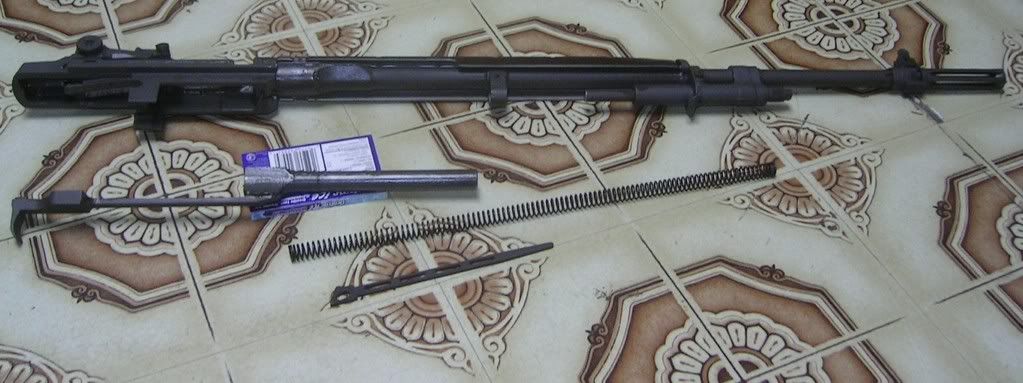
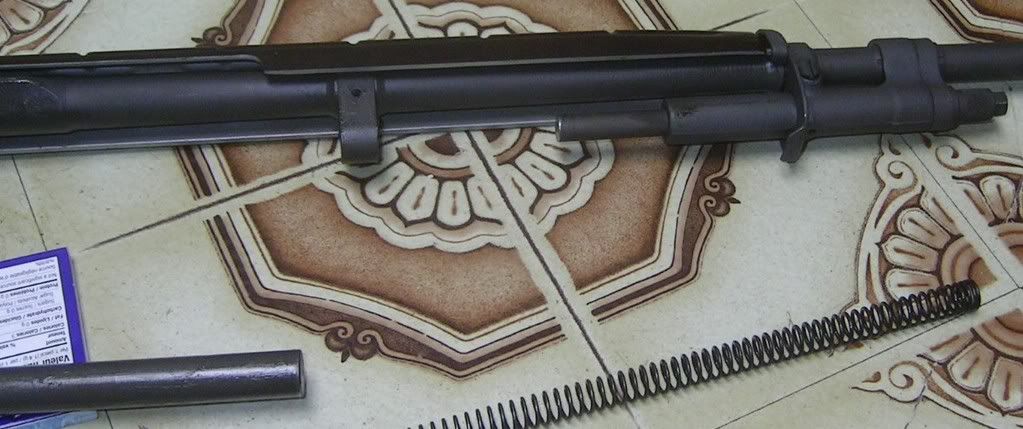
Now we all know our bro Red Collar is a huge fan of M14 rifles. I've talked with him a lot about how they work inside, etc so I figured I'd post some pics to show him exactly what the heck is going on.

So..Here's a course on the inner workings of an M14 or M1A rifle!


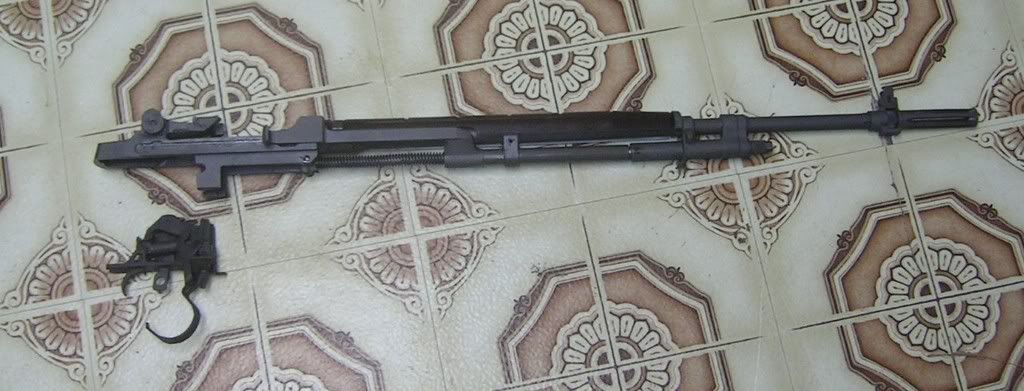
First picture: Here's the M14 stripped down for cleaning in the field. Not a detailed clean, but just what ya have to worry about. On top is the rifle, removed from it's wood stock by unlatching the trigger guard and pulling out the firing mechanism. Underneath the rifle is the operating rod (Op Rod), the op rod spring, and spring guide. When assembled, the end of the spring pointed left goes over the guide, and the end to the right goes inside the op rod tube.


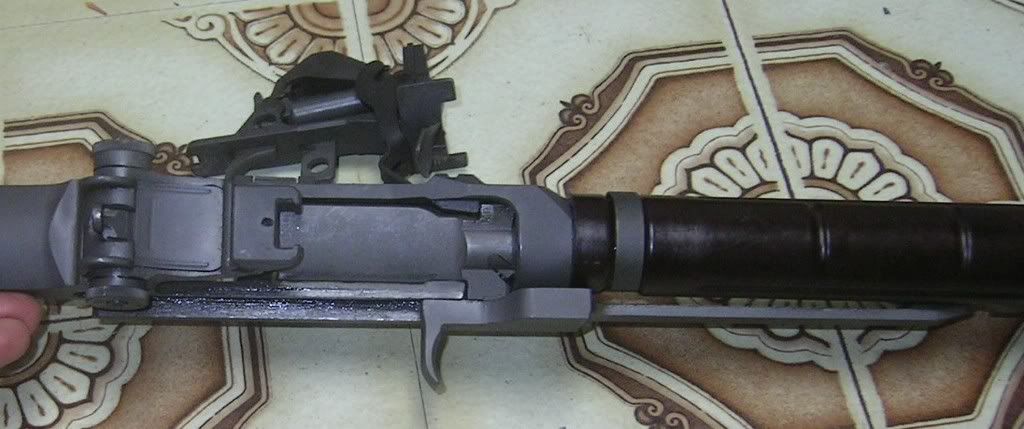
Second picture: Slightly right of the middle of this picture is the gas cylinder, underneath the barrel. If you look closely, you'll see the gas piston sticking out a few inches to the rear of the gas cylinder. Normally it is inside, and it is only exposed about .25 of an inch. On the bottom left is the front of the op rod. When assembled, it sits almost flushly against the gas cylinder, resting on that .25 inch of gas piston.

On firing the rifle, hot gas from the propellant race down the barrel and some are diverted into the gas cylinder. They hit the gas cylinder and force it rearward into the exposed position above with great force. The gas piston in turn smacks the op rod on the face, driving the op rod back, and compressing the op rod spring. The op rod takes the bolt with it all the way to the rear of the receiver, which ejects the empty casing. As it hits the end of it's travel, the op rod spring pulls the op rod and bolt forward again, chambering a fresh cartridge and cocking the hammer of the rifle. The gas piston is smacked by the op rod and driven back into hiding inside the gas cylinder.


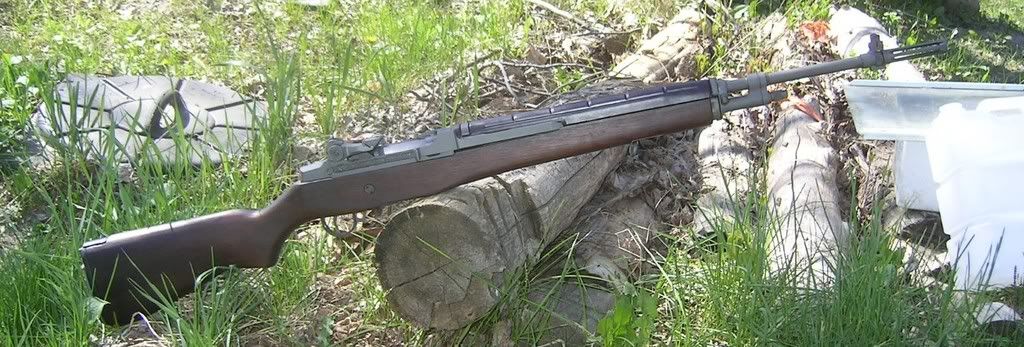
Third picture: Here is the assembled rifle. You can see the face of the op rod is against the gas piston, which is back inside the gas cylinder where it belongs, and that the op rod spring is in position, with most of it actually inserted into the op rod. The firing controls are also shown. They are the trigger, hammer, and safety of the rifle. You can also see the trigger guard has been pulled open. That's all that is neccessary to remove the rifle from the stock. No screws, no tools.


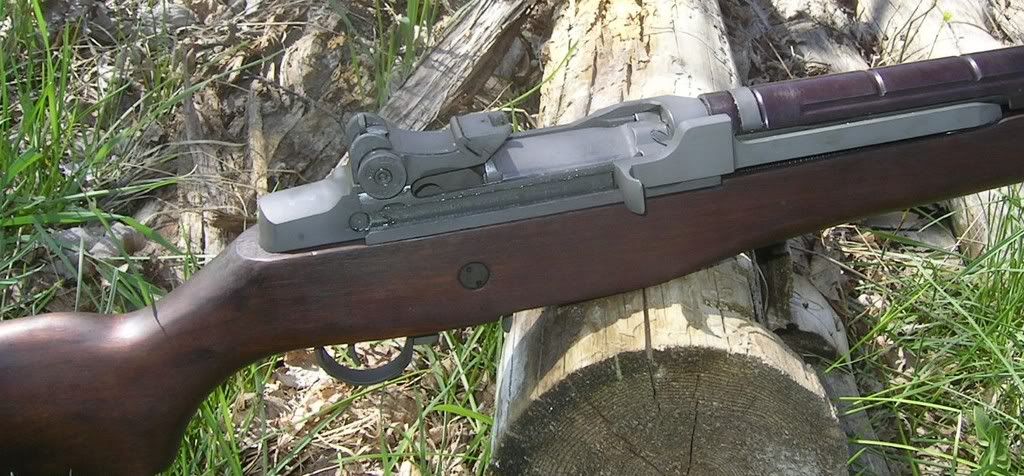
Fourth picture: Here's the top of the rifle. You can see here where the front of the bolt's bottom lug (right hand actually) fits into the op rod to link the bolt and op rod together. When the gas piston slams the op rod rearward, it brings the bolt with it, camming and tilting the two locking lugs out of their grooves in the receiver and unlocking and opening the action when gas and pressure levels are safe.

Well, there's a basic course on the internal parts and operation of the M14...Hope it wasn't too boring!

If anyone wants more detailed explaination or to see more pics, just let me know!

Sunday, May 13, 2007

M14 Rifle

Hey all,

Just came home from a session with the M14! I was finally able to pick her up from the shop on Thursday night, but today was my first day off from work.

Overall, I gotta say...this is a CRAZY deal for $499. A real 7.62x51mm NATO battle rifle, available in Canada, even for shooters on a budget. Or even cheap bastards like me. What's not to love?

Well...It does have a few shortcomings. The Chu wood stock is not as good looking or durable as US walnut, but you can exchange that for $100. 5 round magazines suck hard, but such is Canadian law. And the sights are not as robust as US models, but you can just drop in a set from a Garand or a US made M1A or M14 rifle, they just fit right in.

Bear in mind a US rifle is $1900 and you can see why there's a couple cut corners here.

Now the good news...its actually closer to the old US Military M14 rifle than the Springfields we buy for $2k dollars! A forged receiver, as opposed to cast, a one piece firing pin, tighter gas system, and flash hiders already bored out to National Match specifications. Can't go wrong.

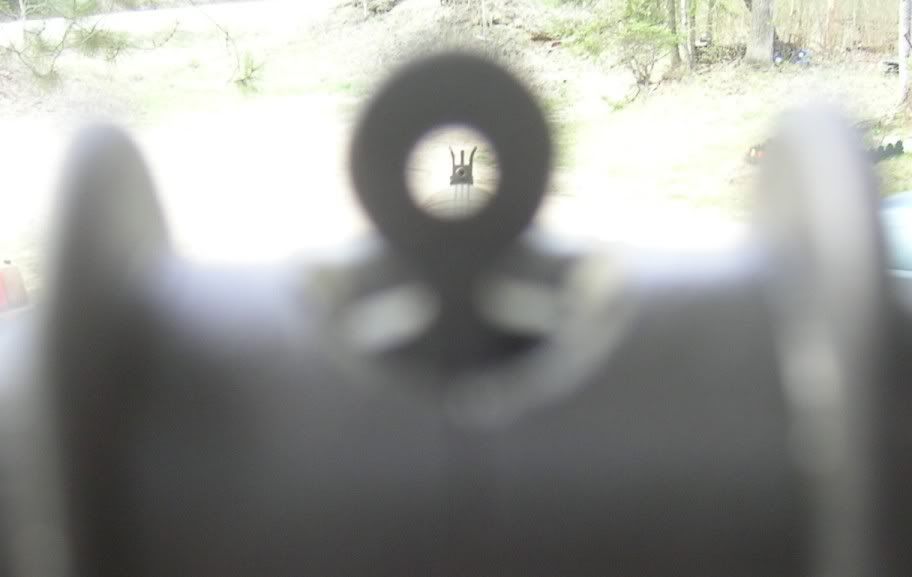
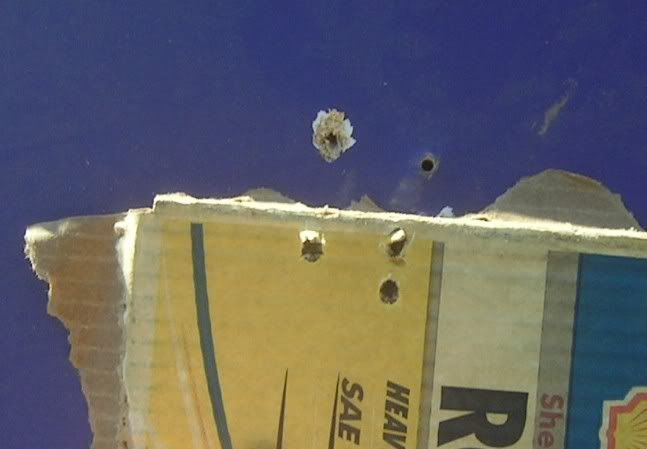
I'm actually VERY surprised by the accuracy of this rifle. In the last two pictures, you get an idea of the sight picture, and there's a group I shot today. Four rounds into two inches, from standing supported, with Remington hunting ammo. Not too shabby for an eyeball and iron sights huh?

7.62x51mm NATO, which most of us know as 308 Winchester, is a very powerful rifle round. It can shoot accurately from an M14 to 500 meters if the shooter does their part, defeat cover which would laugh at a C-7 or M-16 rifle, and is plenty enough gun for even moose hunting. Cheap surplus ammunition is still available in Canada to shoot holes in targets other than your wallet.

The sights on this rifle (as well as the Garand) have to be the BEST that mankind ever devised. Sharp and crystal clear, easy to see, and fully adjustible.

One click of the dial moves your bullet strike one inch per each one hundred yards you are shooting. Thus:

1 click at 100 yards is one inch
1 click at 200 yards is two inches
1 click at 300 yards is three inches
1 click at 400 yards is four inches

and so on.

So lets say our rifle is zeroed for 200 yards and we want to shoot something 400 yards away. My data book shows a 147 grain FMJ boat tail round dropping 22.3 inches, or almost two feet, at that range. So, one click being four inches at 400 yards, you need simply 6 clicks of elevation to put yourself at 24", and your shot would hit 2 inches high on target.

Pretty simple eh?

Ergonomics are very good. Not AR-15 good, but it's very comfy. Heavier than say, a 30-30 lever action rifle, but no heavier than a scoped bolt action. And the weight does soak up some recoil and allow you to get back on target faster.

Seriously...at this price everyone should buy at least one.

Here's some pics...As usual, click for the big version!